

In 2008, James Greenberger founded the North American Lithium Ion Battery Trade Organization NAATBatt. I recently ad the opportunity to speak with Mr. Greenberger to learn about the history of the organization and what challenges lie ahead for the industry. Below are the major topics of our discussion.
What does NAATBatt do?
NAATBatt is trade organization focused on supporting battery manufacturing in the US. Through conferences, newsletters, and initiatives, NAATBatt fosters collaboration amongst organizations at every stage of the lithium ion battery manufacturing process. By hosting regular meetups and an annual conference, NAATBatt engages with stakeholders at every level of the industry to help foster new connections and collaborations among members. The organization also serves as a representative of the industry for policymakers, often called upon to provide recommendations for incentive programs and to communicate opportunities to members. For example, earlier this year, NAATBatt helped introduce the Li-Bridge initiative, a public-private partnership with the US Government to develop a strategy for fully developing the US lithium-ion battery supply chain. (Source)
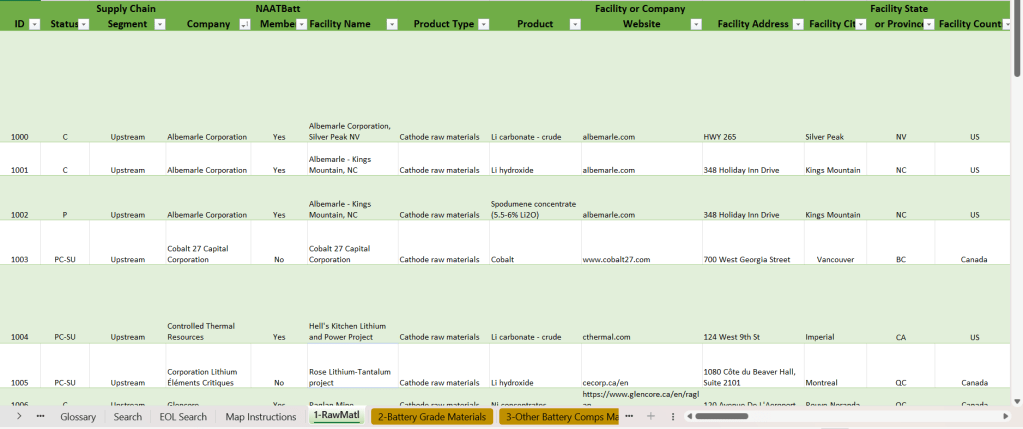
The organization also maintains a comprehensive database of companies in every segment of the lithium-ion battery industry from raw material refinement to battery manufacturing and end-of-life recycling in the US and Canada. This list not only helps companies find one another, but also serves as a critical resource for identifying potential supply gaps and developing long-term strategies for entrepreneurs, researchers, policymakers, and students. NAATBatt releases this database free of cost, making it one of the most valuable and accessible sources of data I’ve come across in the US energy sector. I recommend downloading the database and taking a look whenever you have the chance.
The Origin of NAATBatt
In 2007, Greenberger was an M&A lawyer in Chicago with an itch to transition from his expertise in tech to the budding world of renewable energy. He was familiar with the rapid growth of solar and wind resources and the recent improvements in lithium-ion batteries. Fascinated by the necessity of energy storage, Greenberger decided to organize a conference focused on the battery sector. Following a successful event, he was approached by various stakeholders from across the energy industry with a problem: the US needed domestic lithium-ion battery manufacturing. Greenberger responded by organizing an interest group for the development of a lithium-ion battery pilot manufacturing plant in Illinois. Soon after, the group was approved for state funding to build the plant by Senator Obama. But their hopes were extinguished when the Senator announced that he was running for the presidency.
After an unexpected victory, the Obama administration reached back out to Greenberger. They were releasing a recession-era stimulus package and had decided to allocate funds for the lithium-ion battery manufacturing plant. With Greenberger’s guidance, the stimulus package included $2 billion earmarked for lithium-ion battery manufacturing. The colossal funding opportunity not only allowed the largest companies in Greenberger’s coalition to split off and independently begin construction of their own pilot battery manufacturing lines, but it also attracted more attention to the idea of bringing battery manufacturing to the US. Dozens of smaller ventures were started over the next decade, connected by Greenberger’s original group. This small interest group soon became the NAATBatt trade group, and under Greenberger’s leadership, it has grown into the largest lithium battery organization in the US and has been a driving force for growth in the industry.
What Challenges Lie Ahead for Domestic US Lithium Ion Battery Manufacturing?
During our discussion, Greenberger pointed to two challenges that the US will face while scaling battery manufacturing. First is the knowledge gap between the US and China. Today, about 76% of lithium-ion battery cells worldwide are produced in China and the majority of lithium refinement takes place in China. As the US aims to scale manufacturing these cells domestically, the difference in experience between US and Chinese manufacturers will be apparent in both cost and throughput. For US battery manufacturing to be competitive in the long term, it is critical that manufacturers learn and adapt to the advancements made by Chinese manufacturers in the previous fifteen years. Though, many foreign-owned cell manufacturers are being opened in North America because of the high potential returns. By learning and collaborating with these experienced companies, the US can advance its domestic manufacturing capability more quickly.
The second major challenge for US battery manufacturers is cost. Chinese battery cells will be cheaper than US cells in the near and medium term. To keep US battery cells competitive, economic policy will likely need to add environmental tariffs on imported products with higher associated emissions like the cells manufactured in China. This will give US manufacturers a pathway to market competitiveness and encourage US battery manufacturers to develop sustainable supply chains from the beginning.
Thank you to James Greenberger, Executive Director of NAATBatt, for taking the time to speak with me. If you are interested in learning more about NAATBatt, I encourage you to explore their website or sign up for the NAATBatt weekly newsletter.
Links:
NAATBatt Website: https://naatbatt.org/
Supply Chain Database: https://www.nrel.gov/transportation/li-ion-battery-supply-chain-database.html
Li-Bridge Initiative: https://naatbatt.org/li-bridge-and-the-age-of-electricity/

