

If we were to imagine an electric grid like a national highway system made up of dozens of roads, on ramps, and off ramps, one of the most persistent problems we’d have is traffic congestion. Highways are created to allow the most number of people to travel large distances as quickly and safely as possible. When there are too many cars on the roadway, congestion slows down traffic, defeating the purpose of the roadway. In this analogy, the highway roads represent high voltage transmission lines, moving electricity from generators to substations. If we wanted to reduce congestion on highway, we could increase the number of lanes we had. Similarly, to allow for more power to move across our electric grid, we can reduce the amount of resistance in our transmission lines. High Temperature Superconducting(HTS) technology offers one potential avenue to massively reduce the amount of resistance in our transmission wires, allowing our electric grid to carry more power with lower losses.
Superconductivity is the property for materials to have near zero electrical resistance at temperatures close to absolute zero. In 1986, researchers found that there was a class of materials that exhibited superconducting properties at much warmer temperatures than absolute zero, around -320° F. These were classified as “high temperature” superconductors. This allowed much cheaper cooling methods, such as liquid nitrogen, to be used to maintain these materials at superconducting ranges.
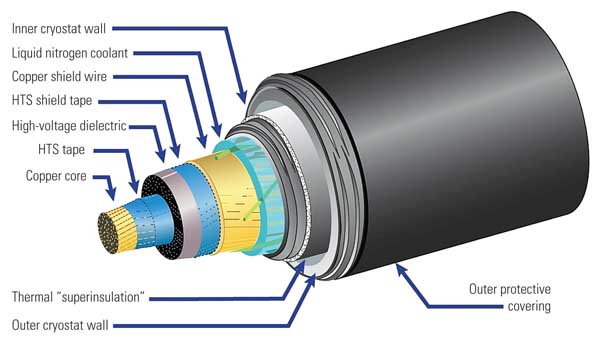
This technology was adapted to create high voltage transmission lines. These cables are made up of a copper core, cooled by a liquid nitrogen coolant and electrically insulated by a dielectric. They have extremely low impedances, and thus lower power losses and less strict siting(geographic) requirements.
These two major advantages have been very attractive to grid infrastructure developers, especially in cities and populated areas. The small magnetic fields eliminate the need derate* wires and reduces the size of right of way* zones. This lowers costs for easements and installation of transmission cables. All of these factors have made HTS cables most commonly used for short distances in areas of the grid with high power needs and constrained right of way zones.
There’s a major disadvantage for this technology that has stalled the transition towards these cables. The energy and resulting maintenance costs required to cool HTS cables currently outweigh their power efficiency gains. This is acceptable over short distances and specialized scenarios as described earlier. Over longer distances, these costs become much more apparent. Specialized subcooling equipment needs to be placed every few miles to maintain the cool liquid nitrogen temperatures in the cables. This drastically increases costs for any project involving HTS cables and prevents developers from even considering it.
A startup named VEIR is aiming to solve this “cooling problem” using evaporative cooling technology. They have few details released on the specifics behind this process, though I expect the will reveal more as they get further into development. If VEIR is successful in creating these low voltage lines, it could not only drastically reduce power losses, which will reduce the cost of electricity for all consumers, but it could also lower the cost of large transmission lines that will need to be constructed to carry renewables from rural to urban areas. This will be a major step towards a more sustainable electric grid.
Overall, HTS cables could be the next generation of transmission lines. This will be contingent on solving the cooling problem to economically keep superconducting materials in the necessary temperature zone. Current work in the area from a few key players seems quite promising. It’s exciting to see what the future holds for this technology.
right of way – zone below and around transmission lines where no other structures can be constructed
derate – accounting for factors that could increase temperature
Sources:
 Electric Grid Gossip